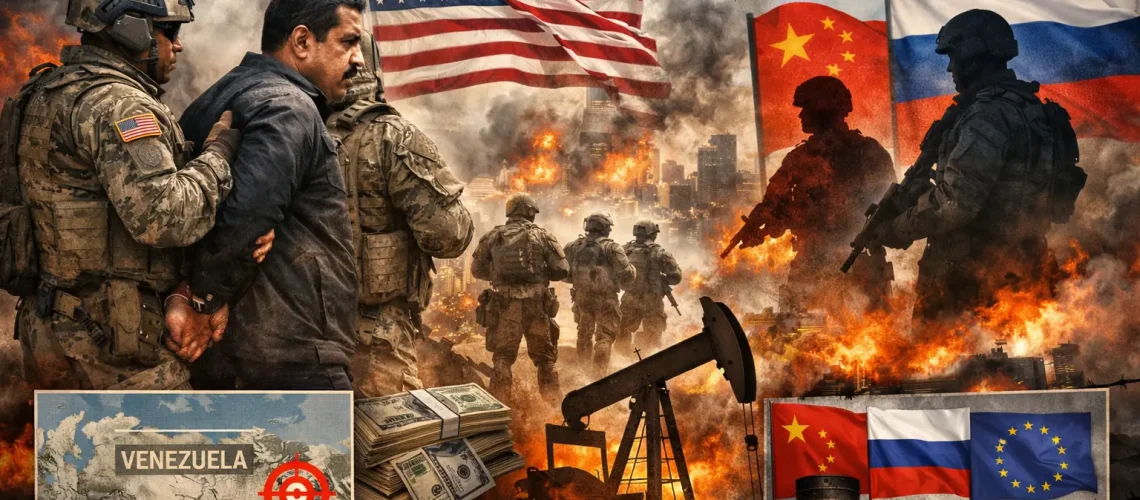

You can call Nicolás Maduro many things: an autocrat, a dictator, a man who ran a resource-rich country into poverty and crushed opposition whenever it became dangerous. All fair. No one needs to mourn him.
But that is not the real question.
The real question is what actually happened on the night of January 3, 2026 — and why this date will likely mark the moment when the old world order finally collapsed.
The United States carried out a military strike on Venezuela. Caracas was hit. Power and communications infrastructure were taken down in precision attacks. In a coordinated operation, Maduro and his wife Cilia Flores were detained and flown to the United States — allegedly to face charges of “narco-terrorism.” Donald Trump summed it up bluntly: We’ve got him, and we’ll run the country for now until a transition is in place.
That is not the language of a warrant.
That is the language of regime change.
And it is the starting gun for a global chain reaction whose scale we are only beginning to grasp.
Law vs. Reality — Why This Was Not “Law Enforcement”
Let’s start with something that should not require explanation anymore: international law is not à la carte.
Article 2(4) of the UN Charter is unambiguous: states shall refrain from the threat or use of force against the territorial integrity or political independence of any state.
Yes, there are exceptions. Self-defense. A UN mandate. Gray zones like humanitarian intervention are endlessly debated. But none of this was cleanly established here. Instead, the operation was sold as a hybrid of anti-drug enforcement, counter-terrorism, and moral necessity.
That does not hold.
A U.S. criminal indictment does not constitute legal grounds for bombing a foreign capital and extracting a sitting head of state. Even if one believes the charges against Maduro are valid, the leap from indicted to military extraction is precisely where the rule of law ends and empire begins.
This matters because the United States has indicted foreign leaders before — without invading them. Law enforcement operates with extradition treaties and courts. Armies operate with force. Confusing the two is not a technical mistake; it is a political choice.
Domestically, the legal footing is just as shaky. Reports already indicate that the operation was conducted without a clear congressional authorization, triggering renewed debate over the War Powers Resolution. Even under U.S. law, presidents are not supposed to launch large-scale military actions at will.
In short: internationally questionable, domestically contested, rhetorically disguised.
Perfect Timing — “Wag the Dog” Is Not Just a Movie
Now for the uncomfortable part.
Politics rarely runs on coincidence. It runs on timing.
At the moment the Venezuela operation unfolded, the United States was once again approaching a sensitive phase in the Epstein saga: document reviews, delays, pressure to release names, and the growing risk that the story might expand beyond its original circle.
This is not an accusation that Venezuela happened because of Epstein. It is something simpler and more cynical: foreign crises have a long tradition of drowning out domestic scandals.
A dramatic military operation, saturated with patriotic imagery, immediately displaces everything else. Who talks about flight logs to a private island when Marines are “saving democracy” and capturing a “drug king”?
This is textbook agenda-setting. And Donald Trump is not a subtle political operator. He understands spectacle. Venezuela delivered maximum spectacle.
The Fentanyl Narrative — Why It Sounds Like PR
Trump framed the operation as a national security necessity: stopping drugs, especially fentanyl, from killing American youth.
That message resonates. It just doesn’t align with reality.
Yes, Venezuela is deeply entangled in the drug trade. It has long been a transit hub for cocaine, especially from Colombia. Yes, corruption in the military — often summarized under the term Cartel de los Soles — is well documented.
But cocaine is not fentanyl.
The core of the U.S. overdose crisis is synthetic opioids. And the supply chain for illicit fentanyl looks very different: production in clandestine labs run by Mexican cartels, precursor chemicals sourced through international supply chains, with China playing a significant role in chemical exports.
This is not speculation. It is reflected in DEA assessments, CDC data, and every serious analysis of the opioid crisis.
Labeling Venezuela as the centerpiece of a “fentanyl war” is therefore misleading. It takes a real problem and repackages it into a politically effective narrative: protect our children. It works domestically. It collapses under scrutiny.
Resource Politics With a Flag — This Is About Oil
If you want to understand the real gravity, stop listening to the moral rhetoric and look at the ground.
Venezuela holds the world’s largest proven oil reserves. The industry is devastated — mismanagement, sanctions, decaying infrastructure — but the oil is still there.
And Trump was unusually explicit: U.S. companies would help “manage” Venezuela’s oil sector, ramp up production, and stabilize the country.
That is not humanitarian language. That is resource governance by force.
Call it the Monroe Doctrine resurrected in its rawest form. The American hemisphere is being reorganized, visibly and unapologetically. This is not subtle influence. This is territorial thinking with a modern PR layer.
History offers a warning: regime changes justified by economic recovery rarely produce stability. Iraq and Libya stand as reminders that oil does not magically translate into order.
The Latin American Boomerang — Why the Chaos Is Just Beginning
The most dangerous assumption in Washington is the belief that removing the leader cures the system.
Latin America does not work that way.
Historical Memory Is Not Academic
In Latin America, U.S. intervention is not theory. It is lived history: Guatemala 1954. Chile 1973. Nicaragua. Covert operations. Installed regimes. Economic pressure.
You don’t need to claim the U.S. caused every crisis to acknowledge this legacy. When Washington now openly enforces regime change, it triggers reflexive resistance — not only from Maduro loyalists, but from people who despise Maduro yet reject foreign control.
Cartels Are Not Side Characters
This is where the real security nightmare begins.
Organized crime in Latin America is not marginal. In many regions it functions as parallel governance: jobs, enforcement, dispute resolution. When the state collapses, these structures do not disappear — they expand.
Destroying an already fragile state apparatus creates a vacuum. And vacuums are filled by whoever has weapons, money, and networks.
Venezuela has all the ingredients: institutional decay, armed groups, smuggling routes, economic desperation. A “transition government” backed by foreign power may exist on paper — but on the ground, legitimacy fractures quickly.
If the U.S. intends to “run” Venezuela, it faces two options: stay far longer than promised, or install a local elite that cannot survive without American backing. Both scenarios breed insurgency, sabotage, and criminal hybrid warfare.
Libya is not a metaphor. It is a blueprint.
The Global Breach — Normalizing What the West Condemns
Now we reach the core problem.
Russia invaded Ukraine and justified it with security rhetoric. The West rightly responded: borders cannot be changed by force.
Then the United States did exactly that in Venezuela.
Different scale, different context — but the same principle violated: military power overriding sovereignty.
That moral asymmetry is now gone.
This is a gift to authoritarian regimes. Not because they suddenly gain military strength, but because they gain narrative power. Every future intervention can now point back and say: You did it too.
International law shifts from foundation to suggestion.
Taiwan, Georgia, the Baltics — Why This Precedent Matters
It would be comforting to believe Venezuela is contained. It is not.
China and Taiwan
China does not need to invade Taiwan tomorrow. It only needs the rhetorical opening: You enforce order in your region; we enforce order in ours.
Swap “Monroe Doctrine” for “One China Principle,” and the argument is structurally identical. The West’s ability to object just weakened.
Russia and the Testing Ground
Russia thrives on precedents. Georgia is the logical pressure point — cheaper than the Baltics, familiar terrain, ambiguous responses.
The real danger is not tanks rolling in, but “limited protection operations,” cyber attacks, minority protection narratives — hybrid warfare that stays below full escalation thresholds.
Russias temptation to test NATO’s resolve increases.
The “Grand Bargain” — New Yalta or Strategic Drift?
This must remain a hypothesis — but a plausible one.
Trump operates in deals, not doctrines. Venezuela looks like a reassertion of influence zones.
Imagine a silent logic:
The U.S. controls the Western Hemisphere.
China dominates Asia.
Russia reshapes its near abroad.
No world war. Just neighbors being consumed while others look away.
In that world, Venezuela is not an anomaly. It is the prototype.
Europe — Sleepwalking Into Irrelevance
Europe, meanwhile, is still reading the script of 1990.
If the U.S. undermines the rule-based order it once enforced, and simultaneously redirects focus inward, Europe stands exposed — militarily and morally.
Without the American security umbrella, Europe lacks the conventional capacity to deter aggression credibly. The much-talked-about Zeitenwende has stalled in bureaucracy and procurement delays.
When rules dissolve and power prevails, Europe stops being a player and becomes terrain.
Pandora’s Box Is Open — And the Bill Hasn’t Arrived Yet
January 3, 2026 was not a police operation. It was a breach.
A dangerous mix of:
legal narratives that do not justify military reality,
domestic distraction incentives,
openly declared resource ambitions,
and a profound underestimation of cartel-driven power dynamics.
Maduro is gone. But the problem is now far bigger than Maduro.
The world learned something on that night — not from theory, but from force: might sets precedent.
And once that becomes the global grammar again, security disappears everywhere — in Taipei, in Tbilisi, and eventually even in Berlin.
This is the real price of January 3.
And the invoice hasn’t even been issued yet.